Prop firms · 7 min read
Futures Prop Trailing Drawdown and Consistency Checklist
A checklist of trailing-drawdown and consistency rule types for US futures evaluations (Topstep, Apex, and similar). Copy live numbers from the firm. No frozen percents or prices.
Updated 2026-10-20 · TradeLogger Research
Quick answer
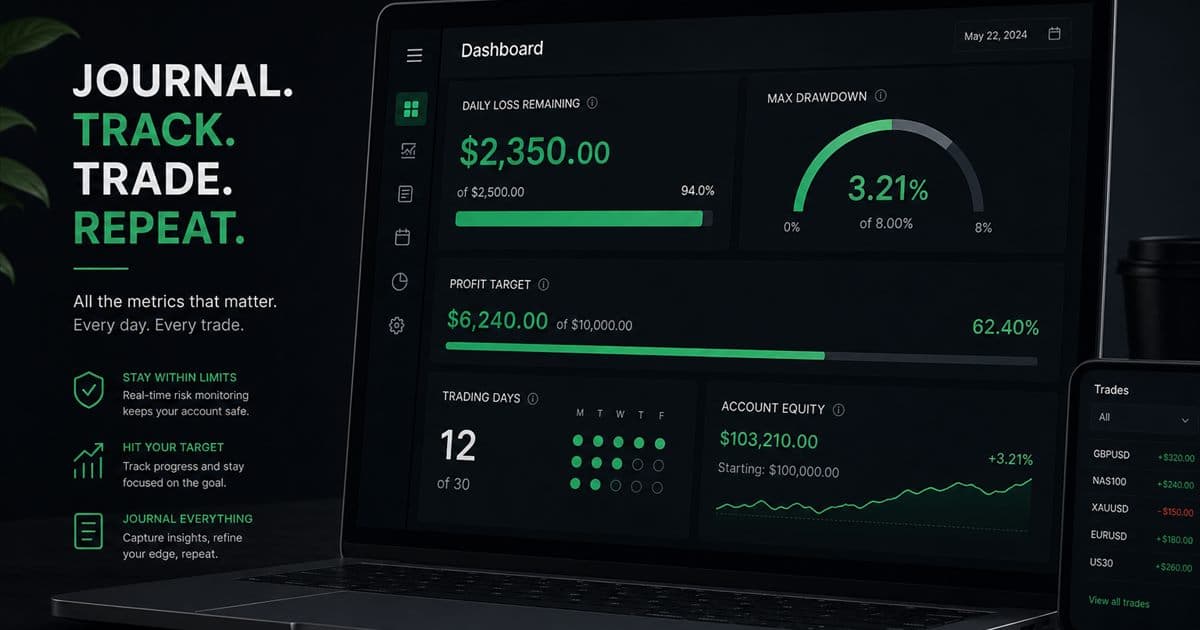
Before each futures evaluation session, identify the rule types that bind you: daily loss, trailing vs static drawdown, whether the trail is intra-day or end-of-day, consistency or best-day caps, news windows, and contract scaling. Copy remaining headroom from the firm’s live dashboard. Do not store last year’s percentages in the journal. TradeLogger does not calculate official objectives.
US futures evaluations (Topstep, Apex, and similar) fail more often on rule types than on “the setup stopped working.” This checklist is a question list for your journal, not a copy of any firm’s current PDF. Pair it with passing prop firm evaluation rules with journals and the foundational guide to trading journals.
What trailing-drawdown questions should you answer before the open?
- Is max loss static from starting balance, or does it trail a high-water mark?
- If it trails, does it use intra-day equity, end-of-day balance, or another snapshot the firm names?
- Does open P/L count toward the trail right now on this account type?
- What is remaining buffer on the live dashboard after the last fill — not your spreadsheet?
- If you just had a winner, did the floor move up so the next loser has less room?
What consistency-rule questions belong in the journal?
- Is there a best-day cap, a percent-of-profit cap, a minimum days rule, or none on this product?
- Does a single oversized ES runner put you near that cap even if you are green?
- Are you about to add size because the dashboard is close to target? That is a process tag, not a setup tag.
- Would a scratch day that followed the plan be healthier than a revenge day that “diversifies” the P&L chart?
What daily-loss and news questions should you tick?
- Daily loss: calendar day vs session vs trailing intra-day — copy the firm’s wording.
- News: is there a restricted window on this product? Tag the trade if a named event was live. Do not reuse last year’s red-folder list.
- Scaling: micros (MES/MNQ) vs minis (ES/NQ) as buffer changes. Standard CME ticks: ES $12.50, MES $1.25, NQ $5.00, MNQ $0.50. Use the tick-value calculator.
How do you attach this checklist to Topstep, Apex, and the execution platform?
Worked examples: how to track a Topstep evaluation and how to track an Apex evaluation. Capture path: Tradovate screenshot or export or NinjaTrader screenshot or export. FX evaluations still use the FTMO challenge journal. Sanity-check dollars with the prop drawdown calculator, then believe the firm.
What does a New York-session pass through this checklist look like?
- Before the US cash open: remaining daily-loss and trailing buffer copied from the dashboard.
- Contract choice: MNQ until buffer is large enough that one NQ tick cluster cannot breach the trail — sized with tick values, not a round lot habit.
- After each trade: screenshot, R, New York tag, and updated remaining room.
- End of day: did one trade dominate? If the firm has a consistency type, check it there, not in a guess.
Frequently asked questions
What is a trailing drawdown in a futures prop evaluation?+
A trailing drawdown is a loss limit that can move up as the account makes a new high-water mark, shrinking room after winners. Some products trail intra-day; others use a different snapshot. Confirm the method on the firm’s current rules page.
What is a consistency rule?+
A consistency rule limits how concentrated profits can be — for example a best-day cap or a share of total profit. Definitions differ by firm and account. Journal daily R and concentration; look up the live formula.
Why does this page omit Topstep and Apex percentages?+
Those numbers change. A stale percent in a journal article is worse than no percent. Use the checklist to know what to ask, then read the firm.
Does TradeLogger enforce trailing drawdown?+
No. Use the free [prop drawdown calculator](/tools/prop-drawdown-calculator) as a personal estimate and the official dashboard as truth.
Related guides
- How to Track a Topstep Evaluation in a Trading Journal
Journal a Topstep-style futures evaluation: copy live daily-loss and trailing-drawdown headroom from Topstep’s dashboard, log ES/NQ screenshots, and measure consistency without inventing current rule numbers.
- How to Track an Apex Trader Funding Evaluation in a Journal
Journal an Apex-style futures evaluation: copy live trailing-drawdown and daily-loss headroom from Apex’s dashboard, log ES/NQ screenshots, and treat consistency and news restrictions as rule types—not frozen percentages.
- Prop Firm Drawdown Tracker: Journal Plus Calculator, Not the Firm Dashboard
How to track prop-firm and FTMO-style drawdown with a personal journal, a free drawdown calculator, and the firm's official metrics. TradeLogger does not replace the evaluator dashboard.
- How to Track Performance for FTMO Challenges
To ensure you stay compliant with FTMO rules, make sure you are constantly tracking your daily loss, drawdown, profit target, and total trading days.
- How to Journal NinjaTrader Trades with Screenshots or Exports
Journal NinjaTrader (NT) futures from chart screenshots or a CSV/export file. TradeLogger has no NinjaTrader API. Confirm fields, tag the New York session, and review in R.
- How to Journal Tradovate Trades with Screenshots or Exports
Journal Tradovate futures from chart screenshots or an export. TradeLogger has no Tradovate API. Confirm fields, tag the New York session, and review ES/NQ in R.
- Forex Trading Journal: Fields, Sessions, and Review Guide
Build a forex trading journal around pair, session, spread, risk in R, chart evidence, execution, and a repeatable weekly review.
- Prop Firm Trading Journal: Track Rules Before You Blow Up
Tracking your progress during proprietary firm challenges requires disciplined journaling. You must rigorously track daily loss, maximum drawdown, profit targets, and the number of trading days.
Use the checklist, then open the firm’s rules
Journal screenshots and copied headroom. Let Topstep, Apex, or your evaluator remain official.
Start free