Content pillar
Prop firm trading journal
Journal prop-firm and FTMO-style evaluations: daily loss, drawdown headroom, setup tags, and why TradeLogger does not replace the firm dashboard.
Updated 2026-10-12 · TradeLogger Research
Quick answer
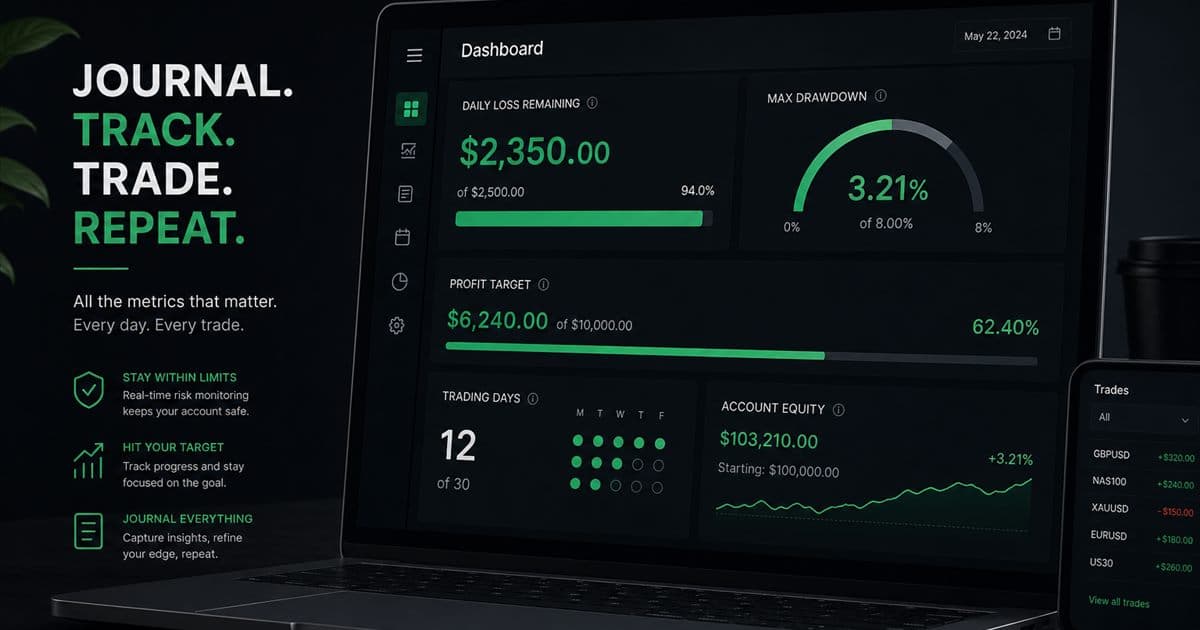
A prop firm trading journal records rule headroom—daily loss, max drawdown, targets, trading days—plus setup and emotion on every trade. Use it beside the firm’s official dashboard. TradeLogger does not calculate official objectives and does not replace the evaluator client area.
Prop-firm journaling belongs at the bottom of the foundational guide to trading journals: you already know the fields; now the constraint is evaluation rules. Pressure invites revenge trades. Pair rule metrics with emotion tags and a short weekly process review. Always reconcile against the firm’s official numbers.
Does TradeLogger replace a prop firm’s official dashboard?
No. TradeLogger does not replace FTMO or any proprietary firm’s client dashboard. It does not compute official profit targets, consistency rules, or payout eligibility. Use the journal for screenshots, R, setups, and emotion. Use the free prop drawdown calculator as a sanity check. Copy live daily-loss and drawdown remaining from the evaluator before you size the next trade.
Before each session, sanity-check headroom with the prop drawdown calculator, normalize outcomes in R with the R-multiple calculator, and confirm lot size with the position size calculator. All three are free public tools. They are not affiliated with any firm.
How should you journal a prop firm evaluation?
Track two layers: the firm’s official remaining limits, and your decision record. Log each closed trade from a screenshot. Tag setup, session, and process mistakes. Write remaining daily-loss and max-drawdown room copied from the dashboard, plus trading days used. If unofficial math disagrees with the firm, the firm wins.
- Prop firm trading journal — rule headroom fields beyond raw P&L.
- How to track FTMO challenge performance — daily checklist without invented rule percentages.
- Prop firm drawdown tracker — journal plus calculator, with the same dashboard limitation.
- Trading journal for day traders — session speed when evaluation days are limited.
- Forex trading journal — pairs, sessions, and spreads when the evaluation is FX.
What does TradeLogger cost for prop-firm journaling?
Sign-up is free. The calculators are free. The journal has no free plan: $4.99/week, $34.99/year, or $69.99 lifetime, with a 7-day trial on weekly and yearly plans. Paying for a journal does not change official evaluation math. Software selection for screenshot capture sits on trading journal software.
Guides in this cluster
- Prop Firm Trading Journal: Track Rules Before You Blow Up
Tracking your progress during proprietary firm challenges requires disciplined journaling. You must rigorously track daily loss, maximum drawdown, profit targets, and the number of trading days.
- How to Track Performance for FTMO Challenges
To ensure you stay compliant with FTMO rules, make sure you are constantly tracking your daily loss, drawdown, profit target, and total trading days.
- Prop Firm Drawdown Tracker: Journal Plus Calculator, Not the Firm Dashboard
How to track prop-firm and FTMO-style drawdown with a personal journal, a free drawdown calculator, and the firm's official metrics. TradeLogger does not replace the evaluator dashboard.
- A Trader's Journal for Day Trading
You need session tags, screenshots, and same-day logging—tools that reliably survive when you hit high trade volume.
- Forex Trading Journal: Fields, Sessions, and Review Guide
Build a forex trading journal around pair, session, spread, risk in R, chart evidence, execution, and a repeatable weekly review.
Frequently asked questions
Do prop firms require a trading journal?+
Usually no. Journaling rule headroom still helps prevent accidental breaches that end an evaluation. The firm’s dashboard remains the source of truth.
Does TradeLogger replace a prop firm dashboard?+
No. TradeLogger is a personal journal plus a free drawdown calculator. Copy live limits from the evaluator. If the two disagree, the firm wins.