Product · 5 min read
TradeLogger Trading Journal App: Examining the Workflow, Assessing the Fit, and Mapping its Limitations
Here is a comprehensive and transparent look at TradeLogger. We break down its features—including screenshot-first capture, editable AI extraction, tagging, calendar review, best-fit users, and any important limitations—so you know exactly what it offers.
Updated 2026-07-30 · TradeLogger Research
Quick answer
TradeLogger functions as a screenshot-first trading journal, specifically built for discretionary traders. It pulls out proposed fields directly from a chart image, allowing the trade row to remain fully editable, while also letting you add setup and emotion tags, plus it supports calendar review. Just to be clear, though, it isn't built as a universal broker-import, replay, or comprehensive deep-analytics suite.
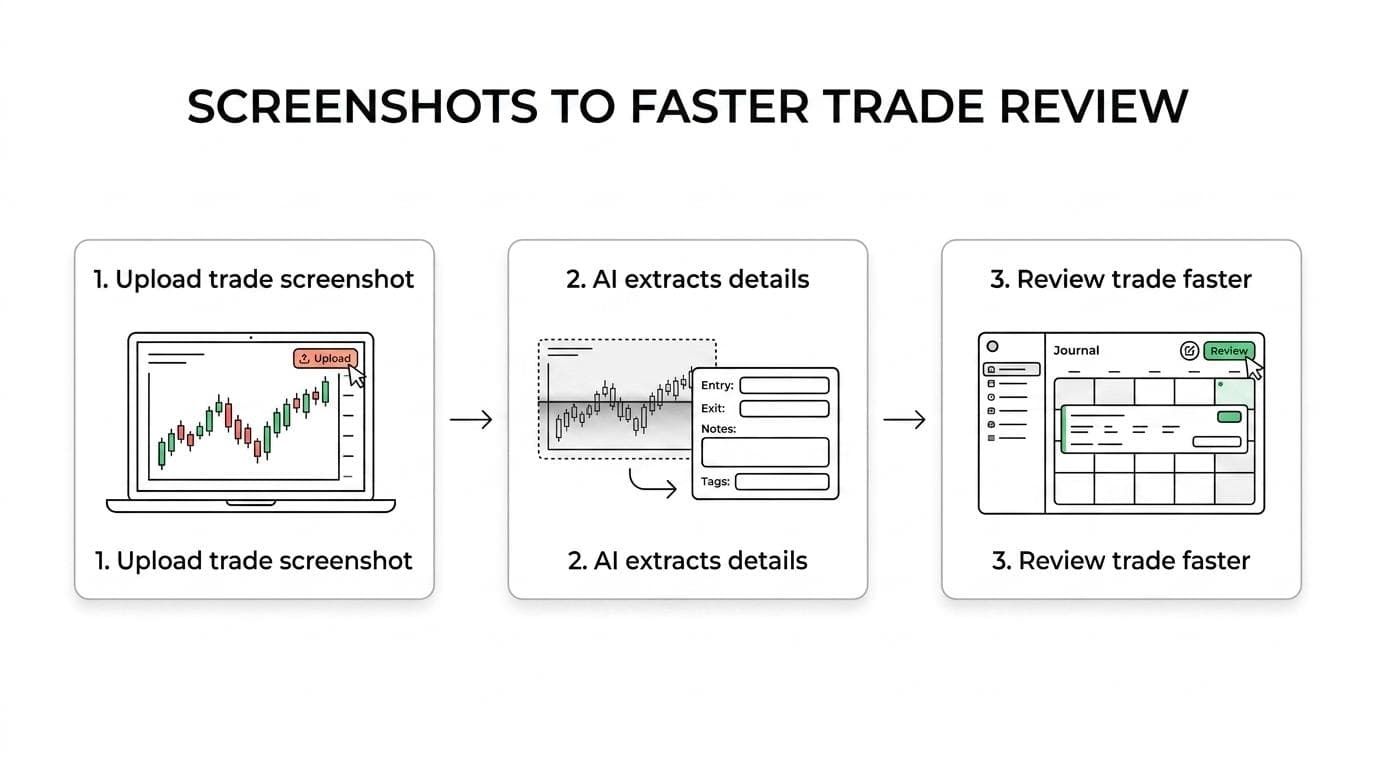
TradeLogger is a focused online trading journal centered on one common discretionary-trader habit: snapping a chart screenshot after you exit a trade. Instead of making the user start with a blank form, it actually uses that image to suggest structured fields. Users can keep these fields fully editable right up until the trade finally enters the tagged calendar-review workflow.
Let's walk through the TradeLogger workflow, step by step.
- Upload a representative chart or broker screenshot.
- Let's break down the parameters outlined in the visual data.
- Go ahead and correct any missing or inaccurate values you find within the editable trade row.
- Apply consistent setup, session, mistake, or emotion tags.
- Archive the trade, then make sure you circle back to it later using your calendar and tag-based review system.
The core concept is this: extraction is designed to assist your verification process, but it absolutely does not replace it. Why the distinction? Because screenshots are inherently varied—they can differ based on resolution, theme, crop, chart layout, annotations, and visible labels. Given all that variability, the resulting proposed symbol, direction, price, or time can easily be wrong, or completely absent. You must correct the row before you treat that information as analysis-ready data.
What does a screenshot-first capture actually preserve?
Broker statements certainly prove execution occurred, but they frequently miss the visual context behind a discretionary choice. A chart, however, retains vital information: it captures location within a specific range, adjacent market structure, volatility levels, marked levels, and the trader's personal notes. By linking that image to specific tags, you can review not merely what transpired, but also the trader's original belief about the market's movement.
TradeLogger is really helpful when you're asking process questions. For instance, did your rule breaks tend to cluster within a single session? Or, did those FOMO-tagged trades exhibit a specific visual pattern? And were the losses you incurred legitimate setups, or just low-quality imitations? Those deeper questions, however, still demand human insight. It's crucial that the tags remain consistent, and frankly, a small sample size should only lead to generating hypotheses—not to confident, sweeping conclusions.
Tags and calendar review
Tags help you transform raw trade narratives into specific, revisitable categories. The most effective taxonomy should be deliberately minimal: a stable setup name, the session, a recorded emotional or decision state, and maybe a single mistake label. Using synonyms—such as “fear,” “nervous,” or “hesitant”—can fragment your sample data. Therefore, you must choose controlled terms that are defined and long enough to allow for genuine comparison.
The calendar naturally sets up a rhythm for review. As you go through the week, scan for any trades you missed, look at unusual outcomes, compare repeated tags, and ultimately commit to one process adjustment. Remember, simply archiving a screenshot isn't valuable in itself. Its true value appears when you can pull it up and retrieve it alongside similar past decisions.
Who is a strong fit?
- For discretionary day or swing traders—especially those who routinely save their chart screenshots.
- It happens often: traders ditch their trading journals simply because filling out the blank forms feels like too much overhead.
- Users needing an editable structure—not opaque, completely automatic AI output.
- Traders, or perhaps coaches, typically review market setups, emotional discipline, and specific calendar periods.
Who should opt for an alternative?
TradeLogger isn't the perfect fit for every trader out there. For instance, high-volume traders often need something with mature broker imports and robust execution reporting. If your focus is on needing integrated market replay, deep prop-firm synchronization, or just a genuinely broad all-in-one suite, you might want to check out products specifically built for those jobs. People who are looking to do deep psychology homework or highly customized research, however, might find a more demanding analytics journal works better for them.
If you aren't capturing screenshots, won't verify extracted fields, or skip reviewing tags, this tool is also a poor fit. When that happens, you'll find that a simple spreadsheet or an import-led tool might generate a much more reliable record.
How do you truly assess TradeLogger?
- You need ten standard screenshots. Make sure to capture them all—this includes dark themes, annotations, instances of losses, and every partial exit.
- We need to track the total duration, starting with the initial upload and running all the way until the row is corrected and tagged.
- Document precisely which fields require repeat corrections or manual completion.
- Commit to a weekly review. You must verify whether the tags are delivering one genuinely useful question or a concrete action item.
- When evaluating options, you must compare the current pricing and limits against alternative providers, basing the analysis on the exact same real trades.
TradeLogger addresses a very specific use case: taking visual trade evidence and converting it into a corrected, tagged record, all while minimizing that usual blank-form friction. If that precise bottleneck is slowing you down, you should test it out. However, if your core focus is on imports, replay, or deep research, you’ll want to look for a solution that fits that requirement instead.
Frequently asked questions
Who specifically is TradeLogger meant to serve?+
This is primarily built for discretionary day and swing traders. They often start their review process by looking at chart or broker screenshots, and they need a way to develop a structured calendar and tagging habit.
Is TradeLogger's AI truly always reliable when extracting trades correctly?+
No. Even though Extraction suggests fields, it is prone to errors because screenshots vary widely. However, the trade row remains editable. This means the trader can always verify and correct the record before they decide to rely on it.
Does TradeLogger function as a replacement for either traditional broker imports or the existing trade replay functionality?+
It doesn't cover everything. Primarily, this tool focuses on screenshot-first journaling. If you are a trader who needs wide-ranging automated imports or integrated replay functionality, you ought to check out specialist or broader suite alternatives.
Where should traders go to check the official pricing for TradeLogger?+
For the absolute latest plans, usage limits, and specific terms, always consult the live pricing page. Since pricing is always subject to change, this article cannot provide a fixed or definitive price point.
Related guides
- The Top Trading Journal for 2026: Evaluating It Via a Workflow-First Scorecard
When selecting a trading journal, you must evaluate it based on four key elements: how reliably it captures data, the quality of the review features, its overall analytics fit, and, critically, whether the habit sticks even during tough market sessions.
- How AI-Driven Trade Analysis Can Secure Your Market Edge
You can leverage screenshot field suggestions and structured pattern review to cut down on journal friction, allowing you to properly test various possible trading edges without the trap of overselling automation.
- TradeLogger versus TradeZella: Focused Journaling or a Comprehensive Suite?
Let’s put TradeLogger's screenshot-first journal side-by-side with TradeZella, considering its modern dashboard, replay capabilities, imports, and wider trading workflow.
- Weekly journal reviews are absolutely essential if you want to improve your performance in trading. By meticulously tracking every single entry, you gain the ability to spot critical patterns—whether that's a tendency toward poor risk management or letting emotion drive your decisions. Make sure you analyze your win rate, average profit, and maximum drawdown over the course of the last seven days. This kind of systematic examination helps traders make smarter, more informed calls and, ultimately, achieve more consistent results in the market.
A weekly review checklist, designed for 30–60 minutes, that converts your trade logs into specific rules for the following week.
Try the complete loop
Upload one representative screenshot, correct the proposed fields, add your normal tags, and decide whether the review workflow fits.
Try TradeLogger