Software · 6 min read
Best Trading Journal in 2026: A Workflow-First Scorecard
Choose the best trading journal by capture reliability, review quality, analytics fit, and whether the habit survives difficult sessions.
Updated 2026-08-15 · TradeLogger Research
Quick answer
The best trading journal is the one that reliably captures your normal trades and turns them into a useful weekly decision. Choose screenshot-first tools for visual discretionary context, import-first tools for execution scale, and deeper analytics tools only when you will maintain the required data.
The best trading journal is not the product with the most dashboard tiles. It is the system that captures honest evidence when motivation is low, keeps definitions consistent, and produces a review decision you can apply next week. That makes “best” dependent on workflow: screenshots versus imports, discretionary context versus execution scale, and simple review versus deep research.
First choose your source of truth
A journal cannot preserve evidence it never receives. For a discretionary trader, the source of truth may be an annotated chart showing structure, entry location, and invalidation. For a high-frequency or multi-account trader, it may be a broker file containing fills, fees, and timestamps. For a psychology-focused trader, it may include pre-trade notes and behavior labels. Write down your source before comparing products.
- Screenshot-first: strongest for visual context and chart-led decisions; requires clear images and field confirmation.
- Import-first: strongest for execution volume and fill accuracy; depends on broker, format, and instrument compatibility.
- Manual template: strongest for flexibility and low cost; becomes fragile as screenshots and formulas accumulate.
- Deep analytics journal: strongest for research and psychology homework; demands stable definitions and consistent input.
Use a 100-point trading journal scorecard
- Capture reliability—25 points. Test normal trades, partial exits, symbols, fees, time zones, and screenshots.
- Review usefulness—25 points. Confirm you can compare setups, sessions, emotions, mistakes, and calendar periods.
- Habit durability—20 points. Measure time and skipped entries after a difficult session, not only on setup day.
- Data control—10 points. Check correction, export, deletion, attachment, and historical-access options.
- Required integrations—10 points. Verify your exact broker, replay, prop, or coaching workflow.
- Sustainable cost—10 points. Compare current plan limits with the features you will actually use.
Weighting prevents a flashy but irrelevant feature from deciding the purchase. If replay is central to your process, move points toward replay. If you take few trades but write detailed chart notes, increase screenshot and reflection weight. The scorecard should describe your work, not force every trader into the same ranking.
What a useful weekly review must answer
Logging without review creates an archive. Before choosing software, write three questions you ask every week. Examples: Which setup was followed correctly? Which session generated the most rule breaks? Did losses cluster around a specific emotion or market condition? Could the screenshot support the original decision? If a journal cannot answer your recurring questions without exporting and rebuilding everything, it is a weak fit.
Avoid drawing conclusions from tiny samples. A handful of tagged trades can suggest a question, not prove an edge. Keep setup names stable, separate process quality from outcome, and inspect the underlying trades whenever an aggregate looks surprising. A winning trade can violate the plan; a losing trade can be correctly executed.
Which product category fits you?
Screenshot-first discretionary journals
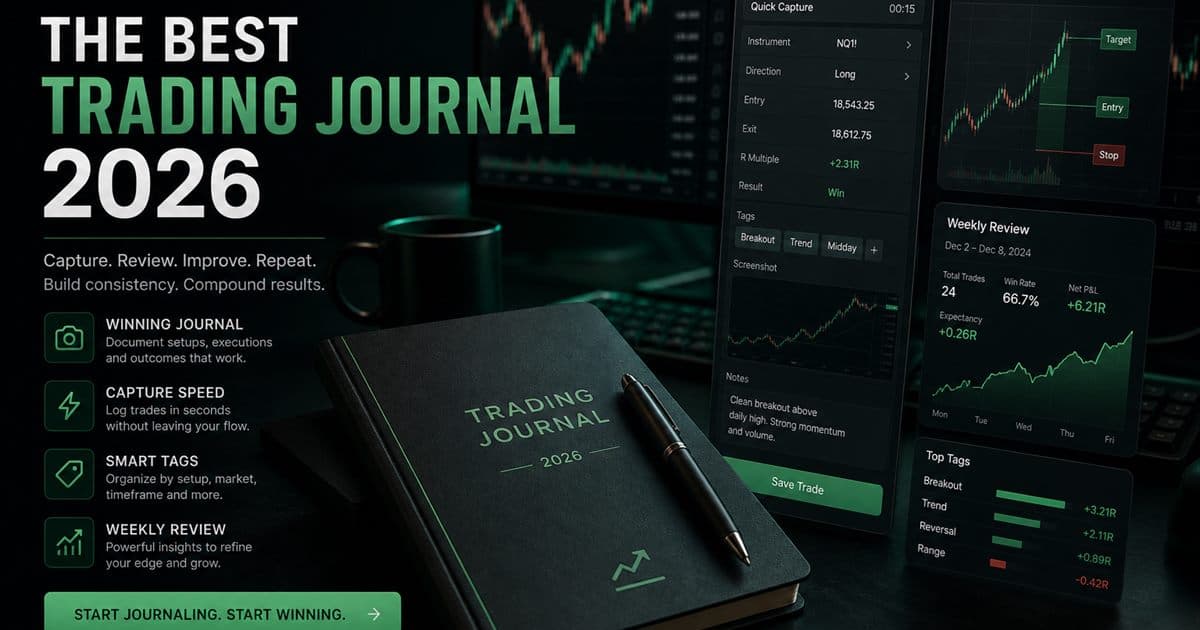
Choose this category when charts carry the context and typing is the habit bottleneck. TradeLogger belongs here: upload a screenshot, review extracted fields, edit the row, apply tags, and use calendar review. It is not the right category when comprehensive broker automation or replay is mandatory.
AI layers in 2026 — do not mix the categories
“AI trading journal” now covers screenshot vision (draft fields from a chart), broker-sync agents (tag and review imported fills), and ChatGPT-style threads. Chat is not a system of record. Broker-sync AI is strongest when the fill file is the truth. Screenshot AI is strongest when the annotated chart is the decision. Score capture and weekly review, not how confident the model sounds. See the dedicated comparison of screenshot AI vs ChatGPT vs broker-sync tools.
Import-led reporting journals
Choose import-led products when execution data is the core record. Tradervue is a mature example associated with imports, reporting, and sharing workflows. Always test exact compatibility; a supported broker name does not guarantee every product, file, or partial fill will map perfectly.
Deep homework or broader suites
Edgewonk is a candidate for deeper psychology and analytics work. TradeZella is a candidate for traders seeking a modern dashboard with broader workflows such as replay, broker imports, and supported prop synchronization. These strengths justify complexity only when you use them regularly.
When free tools are still best
A spreadsheet can be the best journal while your process is changing or your volume is low. Keep it short: date, symbol, direction, risk, setup, emotion, screenshot link, outcome, and lesson. Upgrade when image handling, tagging, consistency, or weekly retrieval becomes the bottleneck—not because a product page implies serious traders must subscribe.
A realistic buying test
Log ten representative trades, including two losses and one complicated execution. Time the capture, count corrections, and run the weekly review. Verify current pricing, plan limits, exports, and integrations directly. Then ask one decisive question: would I complete this exact process after my worst normal session? If the answer is no, more features will not save the habit.
For chart-led discretionary traders, TradeLogger is a focused option worth testing. For import breadth, community, replay, prop workflows, or deeper psychology research, compare specialist alternatives honestly. The winner is the journal whose evidence you will collect and review consistently.
Frequently asked questions
What is the best trading journal overall?+
There is no universal winner. The best journal matches your capture source, preserves the context you review, and remains easy enough to complete after losing or busy sessions.
Should I choose screenshot or broker-import journaling?+
Choose screenshots when chart structure and discretionary reasoning are central. Choose imports when accurate execution data across many fills is the priority. Some traders need both.
How long should I test a trading journal?+
Use it for at least one normal trading week and one weekly review. Include losses, partial exits, and your usual screenshots or import files before judging fit.
Is TradeLogger the best journal for every trader?+
No. TradeLogger is strongest for screenshot-first discretionary traders. Traders needing broad broker automation, integrated replay, or extensive custom analytics may be better served elsewhere.
Related guides
- AI Trading Journal vs ChatGPT in 2026: Screenshot, Broker-Sync, or Chat?
ChatGPT is not a trading journal. Compare screenshot vision tools, broker-sync AI agents, and chat logs — then choose the record you can actually review.
- Best Free Trading Journal: Start Simple, Upgrade on Evidence
Build a useful free trading journal in a spreadsheet, compare free tiers honestly, and recognize the workflow signals that justify an upgrade.
- TradeLogger Trading Journal App: Workflow, Fit, and Limits
A transparent guide to TradeLogger's screenshot-first capture, editable AI extraction, tags, calendar review, best-fit users, and limitations.
- How to Review a Trading Journal Weekly
A 30–60 minute weekly review checklist that turns trade logs into next-week rules.
Test the workflow, not the claims
If screenshots are your source of truth, log one representative trade in TradeLogger and see whether the weekly-review path fits.
Try TradeLogger