Fundamentals · 5 min read
7 Common Trading Journal Pitfalls That Obscure Your True Outcomes
Seven typical trading journal errors—and how they mess up your review—plus a practical workflow for creating records that are both complete and truly comparable.
Updated 2026-07-30 · TradeLogger Research
Quick answer
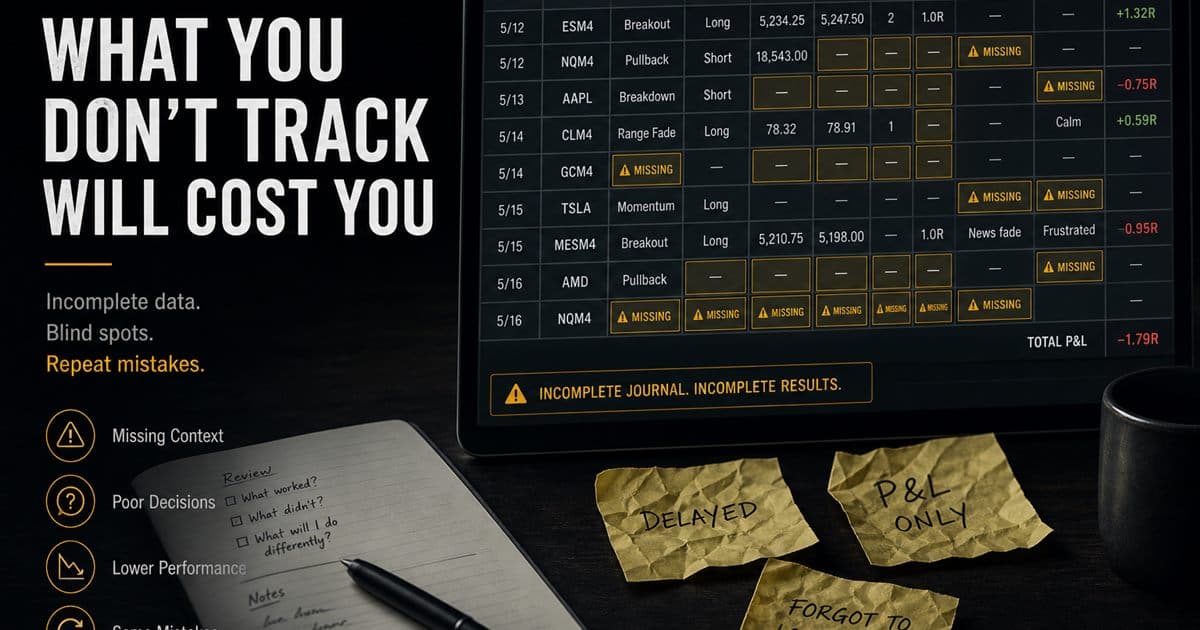
The most detrimental errors in a trading journal include delayed entries, failing to note context, using inconsistent tags, relying on unverified data, limiting reviews strictly to P&L, selective logging, and changing your rules before the sample is truly useful.
A journal that looks complete can still be weak evidence. The usual flaw is inconsistent logging: one trade a screenshot, the next a paragraph, the third only P&L. Mismatched records make review anecdotal. Fix completeness and timing first. This spoke sits under trading journal basics and the foundational guide to trading journals.
1. Documenting the trade long after the initial market noise has dissipated.
End-of-week reconstruction is quick, certainly, but remember it only logs your current interpretation, not the actual decision you made. Following a loss, you might recall the setup as being clearly weak; yet, once you achieve a winner, that exact level of uncertainty vanishes. Always capture the chart, the time, the planned risk, the setup name, and your immediate emotion right on the trade date. If your schedule is tight, implement a two-stage process: save the bare minimum evidence immediately, and then add one concise lesson later.
2. Documenting Profit and Loss When Risk Wasn't Strategically Defined
You can't simply compare money results head-to-head when the variables—like position size, volatility, or stop distance—are constantly shifting. Take, for instance, a £100 profit; that might signal brilliant execution if you were operating at 2R, or it could actually be weak if your intended risk was only 0.3R. It's crucial to always record the planned risk and your resulting performance in terms of R, where one R is defined as the amount you intended to lose if the initial stop was hit. Of course, track your currency P&L, too, but never let that figure stand in for an assessment of how good your decision-making truly was.
3. Screenshots left unverified.
Screenshots help maintain context, and while data extraction cuts down on manual typing, remember that neither method is infallibly accurate. Incomplete fields can easily pop up due to things like cropped labels, overlapping drawings, partial fills, or simply strange broker layouts. Before you hit save, always check that editable row carefully: review the symbol, direction, entry, exit, size, timestamps, fees, and result. Think of the chart as your raw source evidence; the corrected row is the structured record that you'll eventually use for filtering.
4. Be wary when dealing with tags that are vague or constantly changing.
Tags only provide value when a label consistently means the exact same thing. If you use “breakout,” “range break,” and “ORB-ish” interchangeably to describe a single setup, you are fundamentally splitting your data sample. You need to build a concise tag dictionary, giving a one-sentence definition to every specific setup. Crucially, always separate the technical setup from the broader market condition and the emotional factor. “FOMO” must be used to describe behavior, not allowed to become a catch-all excuse for every single loss.
- We're talking about the foundational setup—that repeatable entry idea documented right inside your playbook.
- To gauge the correct context, you must analyze the current session, any potential catalyst, the established trend, the trading range, or the dominant volatility regime.
- The execution involved several possibilities: it could have simply followed the original plan, or perhaps involved an early entry/late exit dynamic. Alternatively, the trade might have necessitated a moved stop, or it could have been categorized as over-sized.
- The underlying psychological states range from calm and measured, to hesitant or fearful. Other drivers we track include impatience, and, of course, the powerful, destructive pull of a revenge-driven impulse.
5. Changing the way we look at winners and losers.
Outcome bias tends to praise poor choices that accidentally paid off, while harshly judging solid decisions that simply hit normal market variance. Before you even look at the final outcome, grade the process first. Check this: Was the setup valid? Was the risk kept within the defined plan? Did the entry and exit adhere strictly to the stated rules? After that assessment, compare the resulting grade against R. Remember, taking a calculated loss can confirm your discipline; however, even a profitable rule break must always be flagged as a process failure.
6. Focus Your Logs: Only Record the Memorable Trades
If you skip scratches, tiny losses, or average winning trades, you are baking survivorship bias directly into your personal trading journal. This process also hides overtrading, since the low-conviction attempts you discard just vanish. You must reconcile your journal against your broker history or the session count. For example, if you executed eight trades, the calendar record absolutely must show eight. Remember this: completeness is always more critical than elegant prose.
7. Shifting the parameters before the sample gets a chance to speak.
When things get rough—a really difficult week, for instance—we often find ourselves tweaking a new setup, filter, indicator, or stop method. If you adjust multiple variables simultaneously, you're going to lose track of what actually worked. Always keep the core definition steady while analyzing a preselected sample, maybe 20 to 30 comparable trades, unless a risk limit absolutely demands you act fast. The rule is to test only one change at a time, and make sure you label your experiment properly so the old and new records never get mixed up.
Weekly Maintenance: Your essential repair checklist.
- Make sure that for every single trade executed, you capture a screenshot and retain an editable row.
- We need to verify the accuracy of all key data points: the prices, the times, the risk assessment, any fees, and the trade direction.
- We need to make sure we normalize any duplicate setup or emotion tags.
- We need to grade the review process itself, specifically before we evaluate the P&L or the win rate.
- We need to compare the outcomes across three specific axes: the trading setup utilized, the session in which the trade occurred, and how strictly the defined rules were adhered to.
- Select one specific pattern to either hold onto or test next week.
The purpose isn't to build a perfect archive. It's to establish a reliable feedback loop that you'll actually use, even after a rough session. TradeLogger streamlines capture by converting a screenshot into editable fields, allowing you to tag and revisit the data on the calendar. Begin with just one screenshot and a tight tag vocabulary; frankly, consistency generates more value than endlessly adding another dashboard.
Frequently asked questions
Seriously, what's the absolute worst mistake traders make in their journals?+
Waiting to document things is typically the most damaging move. Why? Because memory has a tendency to sanitize the data, scrubbing the precise context and replacing it with a tidier, simpler narrative. Capture the screenshot and nail down those essential facts on the same day, even if the deeper analysis notes aren't ready yet.
When tracking trades, should my journal focus exclusively on logging the losses, or is there a reason I should track everything?+
Selective logging is a no-go. It instantly creates a biased sample. To keep your setup and behavior comparisons truly meaningful, you must record every single trade—winners, losers, breakevens, scratches, and those rule-breaking trades too.
When logging trades, what is the practical number of tags a trading journal ought to employ?+
Start with a controlled list: setup, session, market condition, and one emotion or execution tag. Add a tag only when you know what review question it will answer.
What's the ideal cadence for going through your trading journal?+
Start with a quick daily completeness check, but don't forget to run a deeper weekly review. While a monthly review works great when dealing with larger samples, you absolutely cannot let it replace that critical weekly feedback loop.
Related guides
- How to Review a Trading Journal Weekly
A weekly review checklist, designed for 30–60 minutes, that converts your trade logs into specific rules for the following week.
- A Trader's Journal for Day Trading
You need session tags, screenshots, and same-day logging—tools that reliably survive when you hit high trade volume.
- What Is a Trading Journal? Definition, Fields, and Examples
A complete definition of a trading journal, the fields it should contain, how it differs from broker history, and how to start.
- Seriously: How to Master Trading
The unglamorous path to better trading: define one setup, control risk, collect evidence, review mistakes, and repeat long enough to improve.
- Stock Trading Diary: Fields, Examples, and Weekly Review
You should structure your stock trading diary by analyzing catalysts, assessing risk in R, documenting chart evidence, reviewing execution quality, and conducting a repeatable weekly review.
- Why a Trading Journal Is Important: 6 Practical Benefits
The value of trading journals for discipline, psychology, and risk management—and what they simply cannot accomplish.
Make the next row complete
Try TradeLogger when screenshot-first capture would make same-day journaling easier.
Start free